
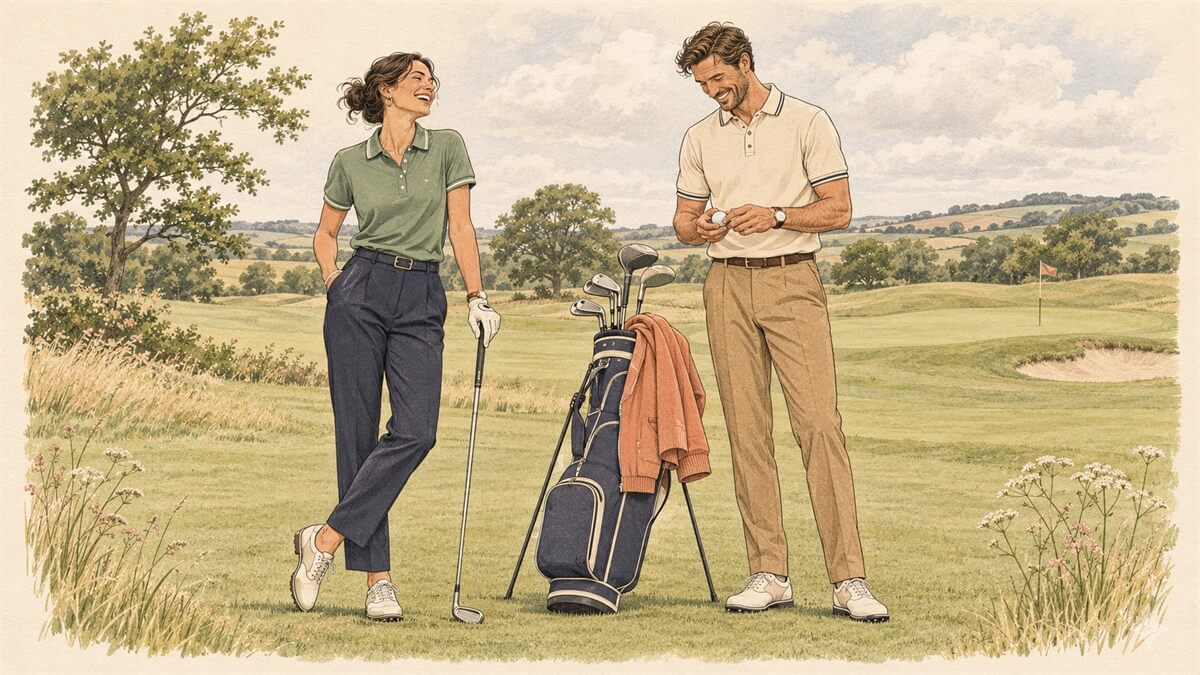
For a first round of golf, start with comfortable clothes that let you turn, bend and walk easily, then check the dress code of the course you have booked. A collared polo, practical trousers or suitable tailored shorts, and the footwear required by the venue make a sensible starting point.
You do not need to buy a complete golf wardrobe before your first lesson. The important decisions are what the venue permits, how the clothes move and whether they suit the weather. This guide covers playing golf in the UK, with outfit ideas you can adapt to your own style and budget.
Check the course, practice area and clubhouse separately
There is no single dress code that applies to every golf venue. A driving range, a public course and a members’ club may have different expectations. The clubhouse can also have rules that differ from those on the course.
For a concrete example, Swaffham Golf Club’s published code requires golf shoes on the course and excludes trainers, while allowing smart denim in the clubhouse. Hayling Golf Club also distinguishes between course attire, clubhouse clothing and event dress requirements. These are individual club policies, not rules for golf everywhere.
Read the visitor information when booking. If it is unclear, ask the pro shop whether your intended shoes and outfit are suitable. It is easier to resolve the question before travelling than to buy something hurriedly on arrival.
A straightforward first-round outfit
| Item | What to look for |
|---|---|
| Top | A collared polo or another style expressly allowed by the venue, with room to turn through the shoulders. |
| Trousers or shorts | A comfortable waistband, practical pockets and a cut that allows bending without pulling. |
| Mid-layer | A light jumper or zip layer that does not bunch under the arms. |
| Footwear | The venue’s required shoe type, a secure fit and grip suitable for the conditions. |
| Outer layer | A packable weather layer with enough room for a comfortable swing. |
| Socks and accessories | Comfortable socks, an appropriate hat and a bag that can hold removed layers. |
Try the outfit together rather than judging each piece separately. A jacket may feel roomy over a T-shirt but restrictive over a jumper. Reach forward, rotate your torso and bend as though picking up a ball. Check that the waistband and hem remain comfortable.
Outfit ideas for different preferences
A simple trouser outfit: a cream polo, navy trousers, a light grey zip layer and suitable golf shoes. The restrained colours make the pieces easy to reuse. You can substitute clothes you already own if their shape, fabric and the venue’s policy allow it.
A warmer-weather outfit: a lightweight polo with tailored shorts, or a golf skirt or skort where permitted. Check the venue’s expectations for length and style. Choose a fit that remains comfortable while bending and walking, and make sure pockets can hold the small items you need.
A cooler-day outfit: a comfortable base layer under a polo, practical trousers and a thin insulating layer. Add a weather shell when needed rather than relying on one bulky coat that restricts movement.
These are outfit suggestions, not requirements to dress according to a particular gender. Choose the combination that fits your body, preferences and the place you are playing.
Can you wear trainers, jeans or leggings?
Trainers: some practice facilities and courses allow them, while others require golf shoes. Ask before relying on an ordinary pair. Even when permitted, worn or smooth soles may be uncomfortable on wet or sloping ground.
Jeans: do not assume that permission to wear smart denim in a clubhouse extends to the course. Jeans can also feel restrictive and slow to dry. A comfortable pair of suitable trousers is often easier to adapt to a round.
Leggings and joggers: policies vary. Some venues accept golf-specific versions or relaxed sportswear, while others exclude them. Check the wording and ask if the distinction is unclear.
T-shirts and hoodies: the same principle applies. A relaxed range visit is different from an invitation to a club with a specified dress code. Our casual-wear guide covers everyday comfort, but the venue determines what is acceptable for your booking.
Choose shoes for walking as well as swinging
A round can involve substantial time on your feet, so fit matters. Try shoes with the socks you expect to wear and check for pressure at the toes and heel. Do not assume that a stiff new pair will become comfortable halfway through a long outing.
If you are buying golf shoes, compare fit, traction, weather protection and the venue’s rules on sole types. Spikeless styles can be convenient, but their grip and suitability still depend on the shoe and conditions. A label saying “golf” does not make every pair equally comfortable for you.
Keep a clean change of footwear available if the clubhouse requires it. Check whether golf shoes are permitted indoors rather than treating a clean sole as automatic permission.
Plan for British weather
Layers let you adjust without carrying a heavy spare outfit. On a mild day, a light wind-resistant layer may be more useful than a thick jumper. For rain, check the product’s actual weather-protection description and whether its fit allows you to move over your other clothes.
Pack spare socks if wet conditions are likely. Keep dry clothing protected in the bag and avoid leaving a wet layer pressed against your other garments. In warm weather, choose comfortable coverage, an appropriate hat and a fabric that suits the conditions. Clothing marked with a tested sun-protection rating provides different information from an unverified marketing claim.
Spend in the order that solves real problems
For an introductory lesson, confirm the rules and use suitable clothes you already have. If you continue playing, buy the item that addresses your clearest problem first, whether that is uncomfortable shoes, restricted movement or inadequate rain protection.
Second-hand tops and layers can be useful if the condition and fit are good. Inspect cuffs, seams, zips and worn areas, and check care labels. For shoes, assess wear and support carefully rather than choosing on appearance alone.
Before leaving, check the forecast, venue dress code, shoes, movement and a spare layer. Once those are sorted, your outfit can support the day without becoming its main concern.


